
- Current location:
Insulated Drinkware Buyer Pain Points and Bulk Order Checks
Before approving a bulk order for stainless steel bottles, tumblers or travel mugs, agree how the product will be carried, cleaned, shipped and maintained. These details belong in the purchase specification alongside capacity, color and logo requirements.
The selected reviews are not a statistical study and do not replace testing of the exact product you plan to buy.
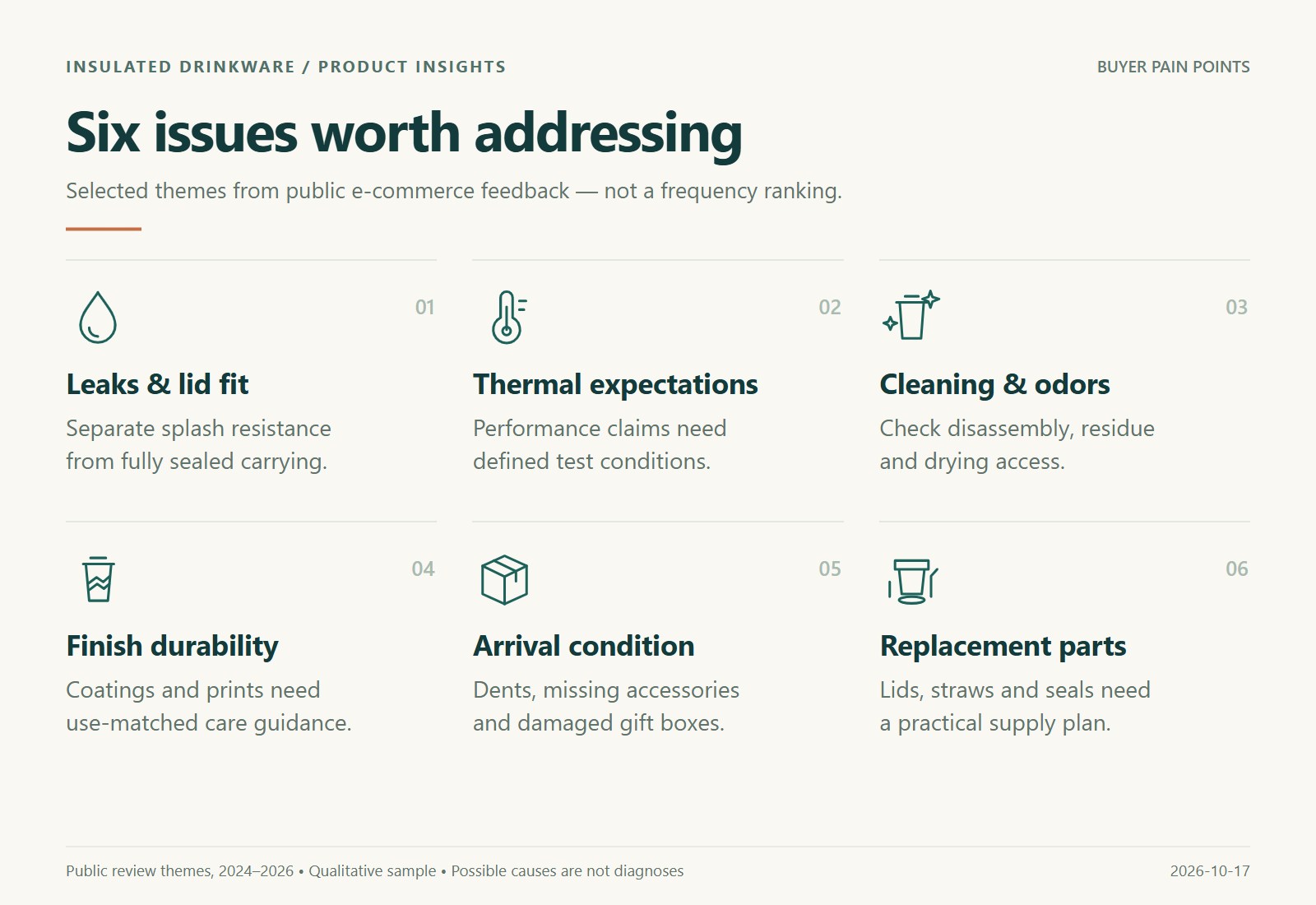
1 Match the lid to the carrying situation
Will the product stay upright on a desk, sit in a car cup holder or travel inside a bag? Confirm the intended use before selecting a lid.
Splash-resistant and leakproof are different requirements. A design with an open straw or drinking path may limit splashes without sealing completely when tipped.
Ask the supplier to identify the intended carrying position and closing steps for each lid version. Check lid fit, gasket retention and opening effort with the agreed sample.
Where side placement, inversion or vibration matters, agree the test conditions and acceptance criteria. A successful result for one lid should not automatically apply to another configuration.
2 Put conditions behind thermal claims
A statement about keeping drinks hot or cold is incomplete without a test method.
Agree the fill volume, starting liquid temperature, ambient temperature, opening frequency, test duration and endpoint temperature. Record which bottle size and lid were tested.
Use those conditions when comparing samples or checking a production batch. Otherwise, an apparent difference may come from the method rather than the product.
Ask for a temperature curve rather than relying only on a duration printed on the packaging. If outdoor or high-ambient-temperature use matters, discuss an additional test that reflects that setting.
Investigate unusual exterior heating, cooling or condensation separately. Customer descriptions can suggest what to check, but cannot identify the cause by themselves.
3 Check cleaning reassembly and drying
Inspect the areas that are easy to miss: lid channels, drinking spouts, valves, internal threads and gasket grooves.
Can the intended user remove the necessary parts, reach drink-contact surfaces and dry the components before reassembly? Ask someone unfamiliar with the product to follow its instructions.
Then check the reassembled lid. Cleaning access should not come at the expense of clear, reliable refitting.
Care instructions should distinguish the body, lid, gasket and decoration. A stainless steel body does not automatically make the complete product dishwasher-safe. Ask for supporting validation if dishwasher suitability is claimed.
First-use odor should be investigated separately; smell alone does not establish a harmful substance.
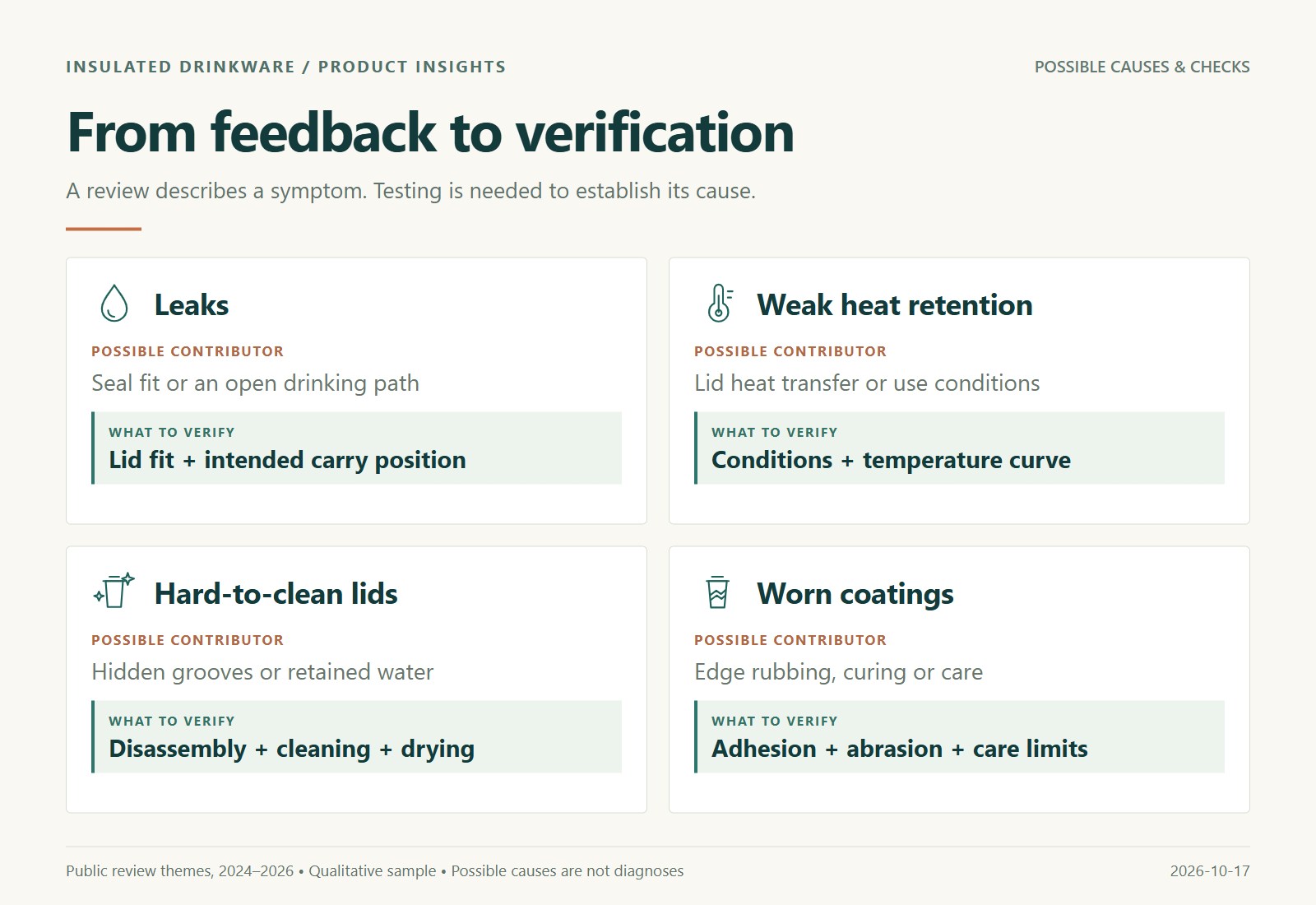
4 Verify finishes specifications and material records
Inspect rims, handles and decorated areas, where rubbing or washing may affect appearance. Agree finish and print checks that reflect the intended use and care instructions.
Separate the appearance of a surface from the identity of the steel beneath it. Clarify whether a finish is bare steel, coating or plating.
A “SUS304” marking on the inner base is not a substitute for a traceable material test report. Request records that can be linked to the relevant component or material batch.
Interior marks also need examination before being described as corrosion; residue and staining should not be diagnosed from a photograph alone.
Check capacity definitions, dimensions and packaging specifications too. Conflicting capacity labels require clarification, but do not by themselves prove that the product is undersized.
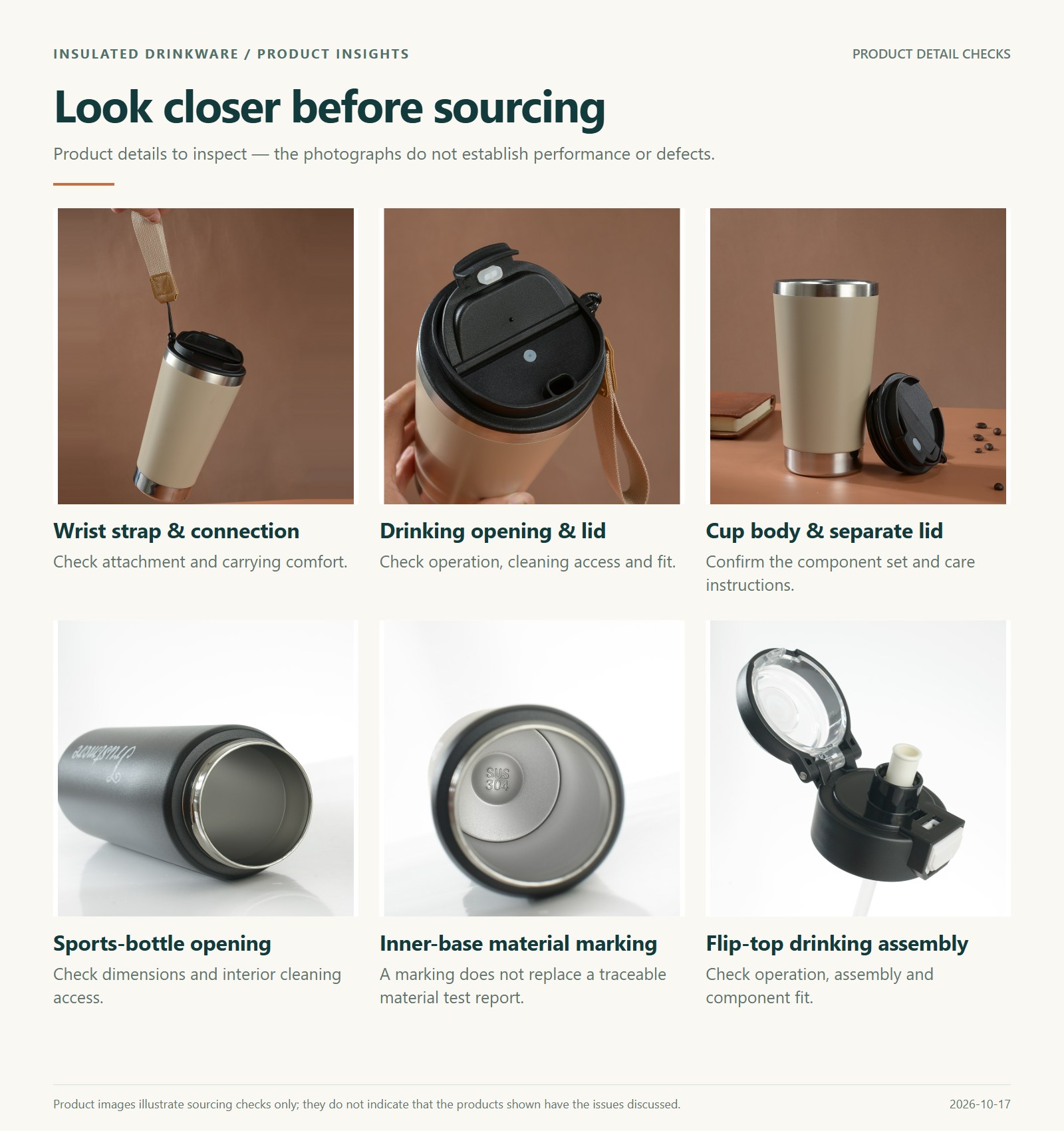
Product images illustrate sourcing checks only; they do not indicate that the products shown have the issues discussed.
5 Protect both the product and its presentation
A gift box and a shipping package serve different purposes. Attractive presentation does not establish resistance to parcel handling.
Review how the bottle is restrained, how multiple items are separated and how accessories are secured. Inspect the box as well as the drinkware after agreed transport checks.
Use a packing list to confirm lids, straws and other included parts. Where factory packing and local fulfillment are separate, agree who checks each stage and what evidence is retained.
Do not assume that a missing part or damaged box originated at the factory without tracing the handling process.
6 Plan replacement parts before shipment
A usable bottle body may outlast its lid, straw or gasket. Ask how customers will obtain those parts before placing the main order.
Confirm separate part numbers, tested compatibility, prices, availability and reorder channels. Agree how design changes will be identified so replacement parts continue to match the correct version.
Avoid assuming that similar-looking lids are interchangeable. Diameter alone does not establish compatibility.
For distributors, discuss an initial service-parts stock alongside the finished products. The quantity and supply period should be agreed for the actual order, not implied by a general promise of after-sales support.
Keep a short traceable approval pack
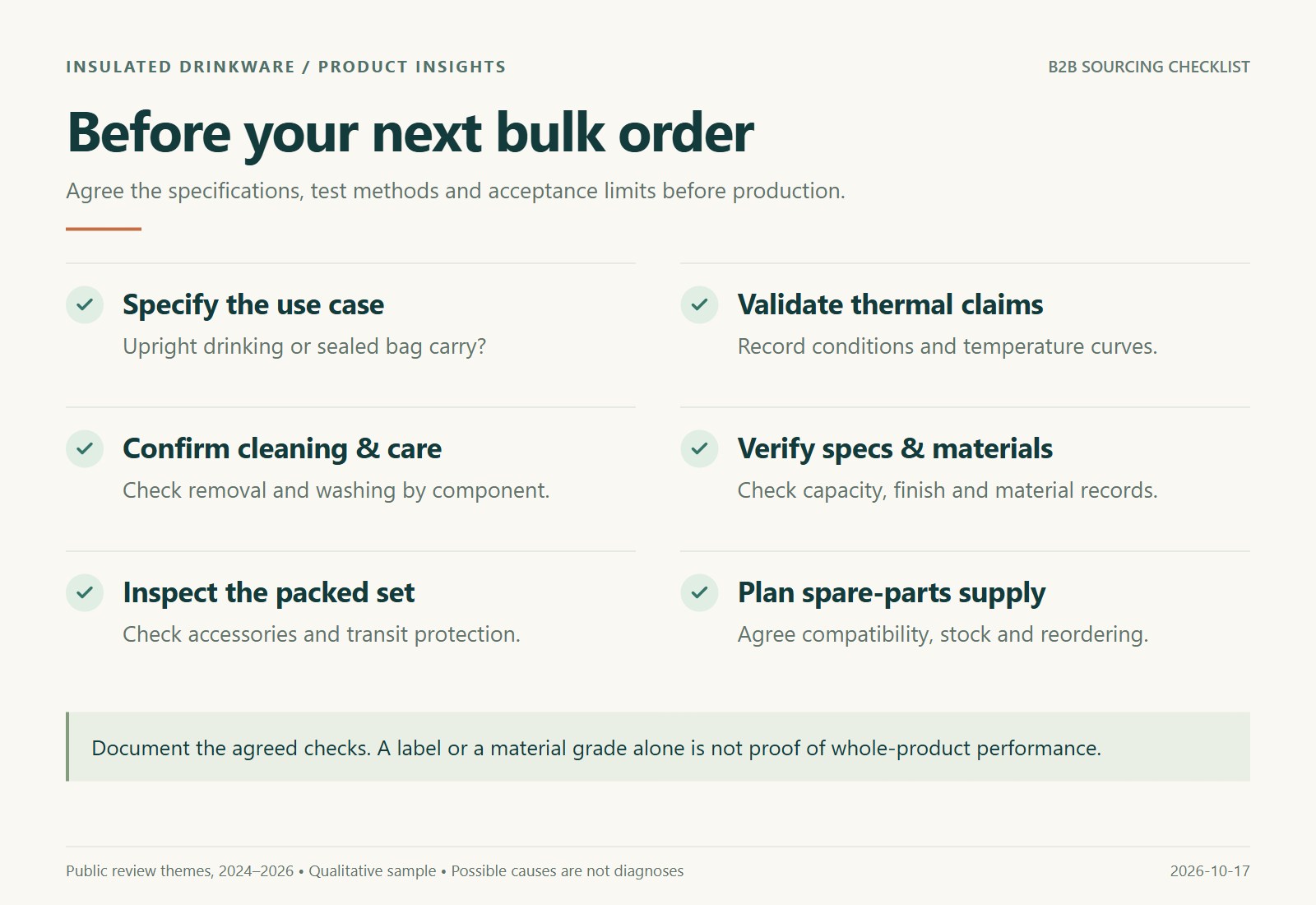
Bring the six checks together in a purchase file:
· Intended use, exact model and lid configuration.
· Thermal test conditions and recorded results.
· Disassembly, reassembly and care instructions.
· Capacity, dimensions, finish definitions and material records.
· Packing list, packaging specification and agreed transport checks.
· Compatible spare parts, version details and reorder arrangements.
Link these records to the approved sample and purchase specification. A generic report for another model should not silently become evidence for the product being ordered.
Record unresolved points before production approval. If a result does not match the requested configuration, ask what remains to be checked and how the gap will be closed.
Prepare a useful quotation request
Send the supplier your required capacity, order quantity, logo requirements, target market and intended use. Include any specific carrying, cleaning, packaging or replacement-part needs.
Ask the quotation to identify the exact configuration and which records, accessories and service parts are included. This gives both sides a clearer basis for comparing options.
Planning a wholesale drinkware order? Contact Jinhua Shenlong Industrial Co., Ltd. with your required capacity, quantity, logo requirements, target market and intended use so the configuration and checks can be discussed.
FAQ
Is splash resistant drinkware suitable for carrying inside a bag
Not automatically. Confirm whether the exact lid is intended to seal fully when closed, and verify it under the agreed carrying conditions. An open drinking path may prevent complete sealing.
Does a SUS304 marking verify the steel grade
The marking alone is not sufficient verification. Request a traceable material test report linked to the relevant component or material batch.
Does a negative review prove a manufacturing defect
No. A review records a buyer’s reported experience. Use conditions, product configuration, cleaning, transport and other factors may need investigation before a cause is established.
Research note
The underlying research reviewed 40 records and supplementary leads, organised into 13 issue themes. Unverified leads were kept separate from verified complaint evidence. The underlying research covers selected public material from 2024–2026, including direct reviews and clearly labelled excerpts, mirrors and supplementary leads.
This is a non-random sample. It does not establish failure rates, complaint rankings or differences between countries. Some listings combine product versions or reviews from different markets.
A reported problem is also not a diagnosis. Odor, interior staining or disappointing temperature retention needs further investigation before assigning a material or manufacturing cause.
Research compiled on 17 October 2026.
Examples of public pages in the research include Target product feedback, bol product reviews and Lazada product reviews. These are source examples, not market-share or defect-rate comparisons.
Tell Us Your Needs And We Will Reply As Soon As Possible.



-

-

Follow Us
